HISTORY OF THE ROSARY
St. Dominic & the Rosary
At the beginning of the 13 th Century the Church was facing many challenges.
Among them was the spread of a strange heresy known as Albigensianism. It
was a strong force in southern France, northern Spain, and northern Italy
between the 11th and 13th centuries. It was a harsh religion that taught that only
the spiritual is good and that everything material is bad. Therefore, the body in
and of itself is evil, and every person’s soul is imprisoned in that evil body. The
only way in which a person could experience salvation or liberation was to be
freed from the imprisonment of their flesh, which was part of this evil material
world.
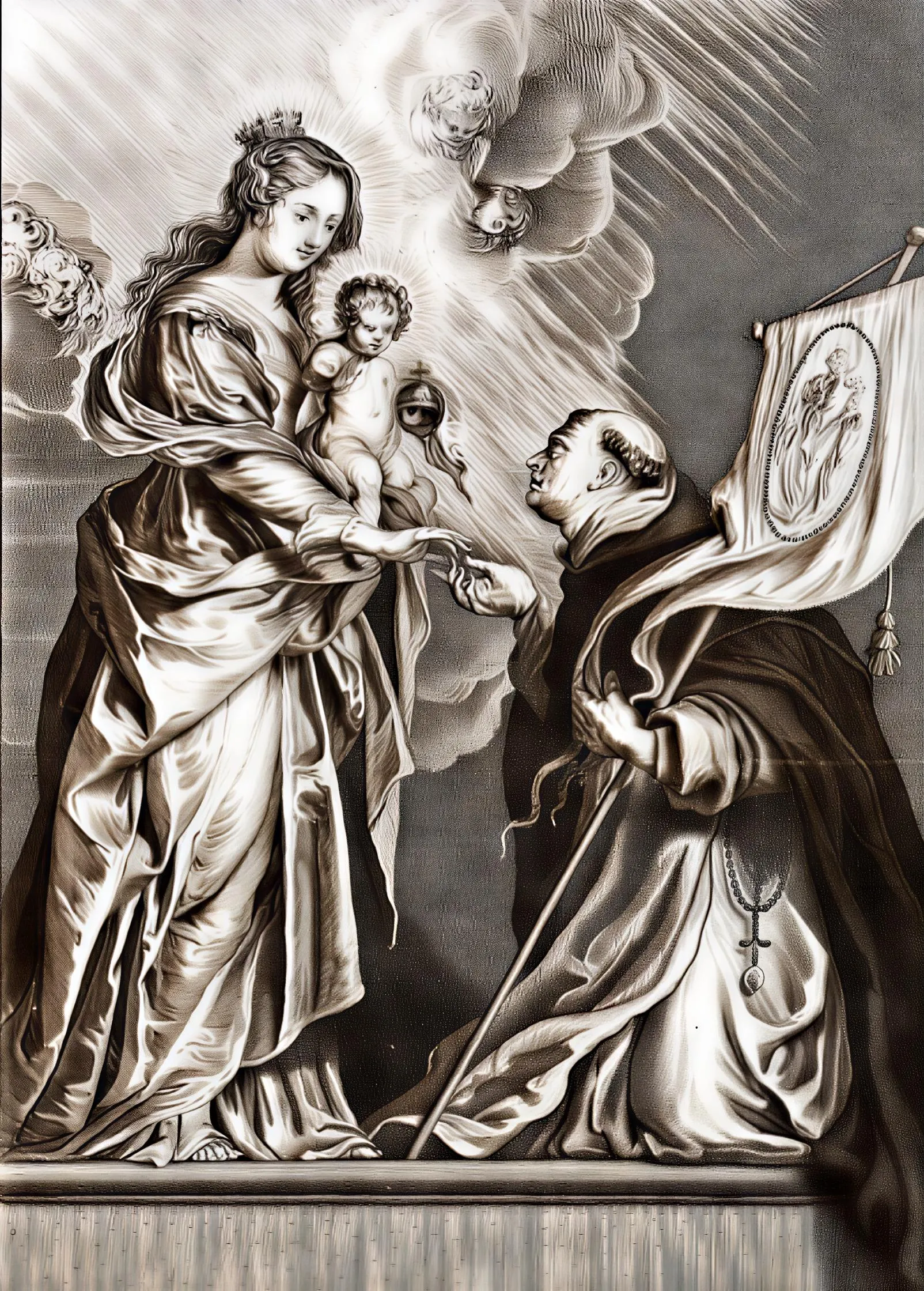
In 1208, St Dominic de Guzman, a Spanish priest and later the founder of the Order of Preachers (Dominicans), traveled to France preaching against the Albigensian heresy, but his efforts gained few conversions and even fewer followers. St Dominic was charismatic, highly educated, and a great preacher, so the failure of his efforts left him downcast and wondering what he was doing wrong. He decided that he needed to retreat into the wilderness to be alone with God and seek divine guidance. So, he went into a forest near Toulouse, France, to pray. After three days of prayer and fasting, three angels appeared in the sky along with a ball of fire. When they disappeared, the Virgin Mary spoke, telling St Dominic that he must preach her Psalter if he wished to succeed in converting the Albigensians to the Catholic faith. The Blessed Virgin appeared with three angels and said, “Dear Dominic, do you know which weapon the Blessed Trinity wants to use to reform the world?” St Dominic’s response was
In 1208, St Dominic de Guzman, a Spanish priest and later the founder of the Order of Preachers (Dominicans), traveled to France preaching against the Albigensian heresy, but his efforts gained few conversions and even fewer followers. St Dominic was charismatic, highly educated, and a great preacher, so the failure of his efforts left him downcast and wondering what he was doing wrong. He decided that he needed to retreat into the wilderness to be alone with God and seek divine guidance. So, he went into a forest near Toulouse, France, to pray. After three days of prayer and fasting, three angels appeared in the sky along with a ball of fire. When they disappeared, the Virgin Mary spoke, telling St Dominic that he must preach her Psalter if he wished to succeed in converting the Albigensians to the Catholic faith. The Blessed Virgin appeared with three angels and said, “Dear Dominic, do you know which weapon the Blessed Trinity wants to use to reform the world?” St Dominic’s response was
that Blessed Mary knew better than he because she is a part of our salvation.
Mary responded, “I want you to know that, in this kind of warfare, the battering ram has always been the Angelic Psalter (The “Angelic Salutation” is the “Hail Mary” prayer and the Psalter is the 150 Psalms. Thus, she wanted 150 Hail Mary’s – which is what the Holy Rosary is – 15 decades of Hail Mary’s with 15 corresponding mysteries to contemplate.) which is the foundation stone of the New Testament. Therefore, if you want to reach these hardened souls and win them over to God, preach my Psalter.” The Marian Psalter that the Virgin Mary gave St Dominic that day is the Rosary we pray today with a few changes and additions.
Mary responded, “I want you to know that, in this kind of warfare, the battering ram has always been the Angelic Psalter (The “Angelic Salutation” is the “Hail Mary” prayer and the Psalter is the 150 Psalms. Thus, she wanted 150 Hail Mary’s – which is what the Holy Rosary is – 15 decades of Hail Mary’s with 15 corresponding mysteries to contemplate.) which is the foundation stone of the New Testament. Therefore, if you want to reach these hardened souls and win them over to God, preach my Psalter.” The Marian Psalter that the Virgin Mary gave St Dominic that day is the Rosary we pray today with a few changes and additions.
Mary responded, “I want you to know that, in this kind of warfare, the battering ram has always been the Angelic Psalter (The “Angelic Salutation” is the “Hail Mary” prayer and the Psalter is the 150 Psalms. Thus, she wanted 150 Hail Mary’s – which is what the Holy Rosary is – 15 decades of Hail Mary’s with 15 corresponding mysteries to contemplate.) which is the foundation stone of the New Testament. Therefore, if you want to reach these hardened souls and win them over to God, preach my Psalter.” The Marian Psalter that the Virgin Mary gave St Dominic that day is the Rosary we pray today with a few changes and additions.

The Marian Psalter is very much the precursor to the Rosary. The Marian
Psalter was a prayer developed by the Cistercian monks, which involved
praying 150 Hail Marys divided into groups of 10 by Our Fathers. Prayer beads
were used to keep track of the Hail Marys. A central part of the monks' daily
life was the chanting of the Psalms in the Bible during the course of each week.
The Psalms were prayed in Latin, so it required a monk to be able to read and
understand Latin. A practice originated here in Ireland of monks who were not
priests and were not well educated enough to read and understand Latin to
participate in the praying of the 150 psalms by praying 150 Our Fathers or
Paternosters. Over time, the Hail Mary prayer gained more popularity under the
inspiration of the Holy Spirit and the influence of St Bernard of Clairvaux, who
had a deep and tender devotion to the Blessed Virgin Mary. So the 150 Hail
Mary’s began to be used to represent each Psalm. This was sometimes called the
poor man’s breviary. However, it was not a meditative or contemplative prayer
at all. It was Mary who revealed to St. Dominic which mysteries should be
preached to correspond to the Psalter prayers: episodes from the Sacred
Scriptures of Christ’s life focusing on the Incarnation, death, and resurrection of
Jesus Christ. With the fire of the Holy Spirit in his heart and the divine gift of
the Holy Rosary in his hands, St Dominic went forth preaching and converting
thousands of men and women back to the Catholic faith.
Blessed Alan de las Roche (1428 -1475)
Over time this powerful prayer began to be called the Rosary taken from
Rosarium, the term used to describe a rose garden. Each Hil Mary was seen as
presenting a beautiful rose as a special gift to the Blessed Virgin Mary.
The next great chapter in the formation of the Rosary as we know it today was the Dominican Friar Blessed Alan de las Roche O.P. (1428-1475). Blessed Alan was a man of great intellect and virtue who was a skilled professor of theology.
The Blessed Virgin appeared to him and told him that she wished him to devote himself to the mission of renewing and spreading her Rosary. However, Blessed Alan was very slow to answer the call. So Jesus took him in hand! He appeared to Blessed Alan and scolded him for not preaching the Rosary saying: “The
world is full of devouring wolves, and you, unfaithful dog, know not how to bark” In using the term “dog” Jesus was referring to the names ‘Dominicans’ or Domini canes – dogs of the Lord. As you can imagine after such an admonition,
Blessed Alan devoted the rest of his life to energetically preaching the Rosary.
He wrote a book on the divine origins of the Rosary and structured it into the 15 mysteries of the life of Jesus for meditation. The Rosary continued to spread
rapidly and became known for helping people quickly grow in virtue and
holiness. Indeed, over the centuries, many miracles became associated with this great prayer so loved by countless millions of people, including saints, mystics, great theologians, and Popes.